
Quick Facts — Evergreen Recyclekaro (India) Limited Pre IPO
| Founded | 2010, by Rajesh Gupta |
| Headquarters | Navi Mumbai, Maharashtra |
| Leadership | Rajesh Gupta (Founder, MD) · Prassann Daphal (CEO) · Rajiv Sanghvi (COO) |
| Business | E-waste, lithium-ion battery & vehicle recycling |
| Annual Capacity | 7,500 MT e-waste + 4,200 MT battery recycling |
| FY25 Revenue | ~₹218.8 crore (up ~75% YoY) |
| FY25 PAT | ~₹22.4 crore (up ~138% YoY) |
| Indicative Market Cap | ~₹1,841 crore (as of Sept 2026, third-party estimate) |
| Key Clients | Tata Motors, Bajaj Auto, Capgemini, NSE, RBI |
| Status | Unlisted, Series A-stage; evaluating an IPO, no DRHP filed yet |
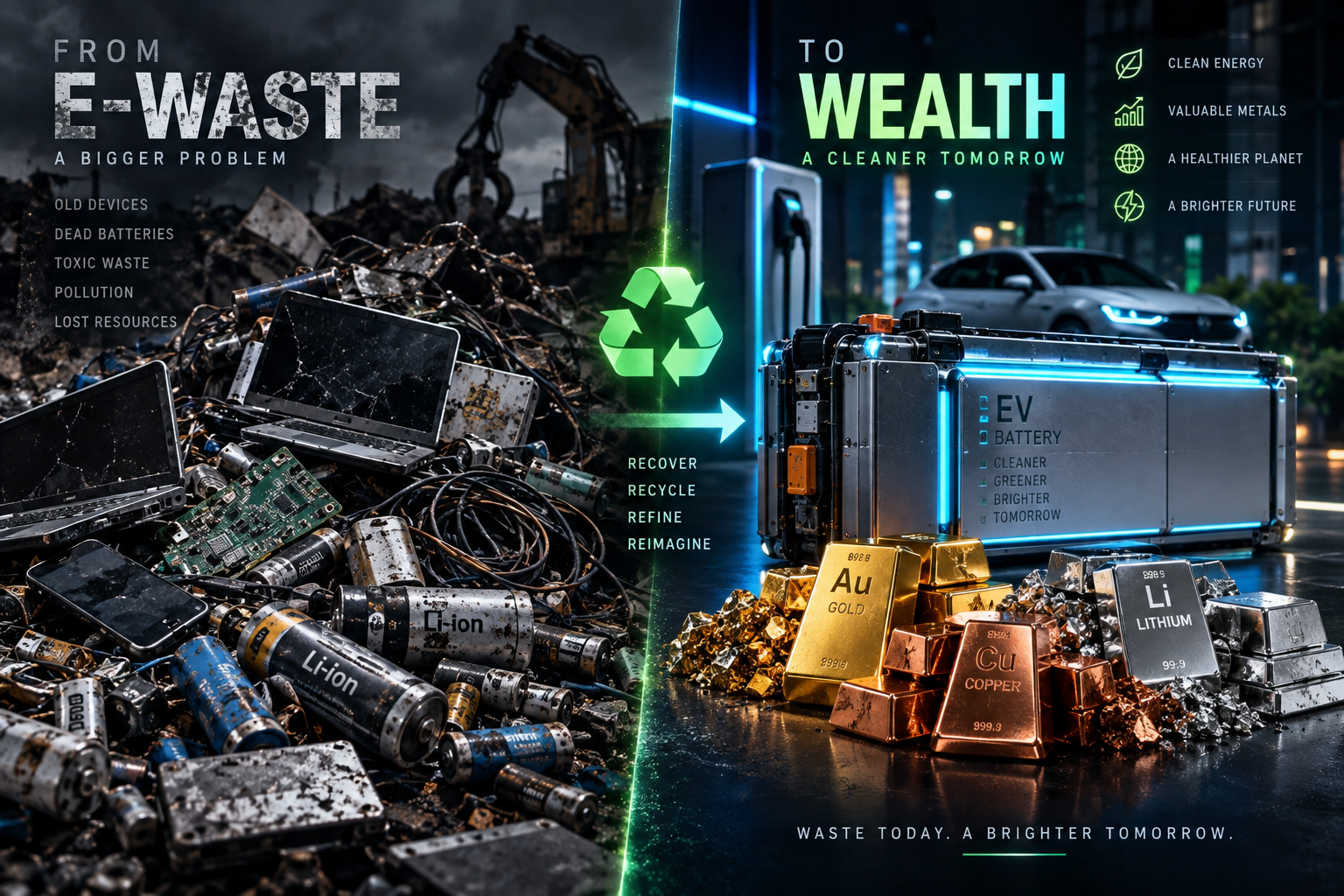
As investor attention turns toward the Evergreen Recyclekaro pre IPO opportunity, India’s recycling landscape is facing a massive transformation. India throws away more electronics every year than almost anywhere else in the world — old laptops, dead power banks, discarded EV batteries, and cables. While most ends up in the informal scrap sector, very few companies have built the infrastructure to recycle safely and at scale.
Evergreen Recyclekaro (India) Limited is one of them — and with rising interest in the Evergreen Recyclekaro pre IPO space, its growth over the past few years offers a glimpse into why India’s recycling sector is quietly becoming one of the more interesting corners of the market.
Evergreen Recyclekaro Pre IPO: From Paper Scraps to Precious Metals
Recyclekaro’s story doesn’t start with lithium batteries or e-waste at all. Founder Rajesh Gupta began the company in 2010 doing something far less glamorous: paper recycling. It took three more years before Recyclekaro moved into e-waste dismantling, starting with a modest 50-metric-tonne facility and its first corporate collection order.
From there, the company built outward in deliberate steps. By 2015, it had begun extracting precious metals — gold, silver, platinum, palladium — from electronic scrap. By 2018, it had a pilot-scale battery recycling plant running. By 2021, it had set up the Evergreen Lithium production plant, which the company describes as India’s first and only dedicated lithium and nickel battery recycling unit.
Today, Recyclekaro operates with an annual e-waste recycling capacity of 7,500 metric tonnes and a battery recycling capacity of 4,200 metric tonnes, spread across an 18-acre facility with a workforce of 300-plus people. The company says it has become the first Indian company to achieve over 99% material recovery from EV batteries — a notable claim in an industry where, according to industry estimates, roughly half the material value in old batteries is typically lost when they’re simply smelted down instead of processed properly.
What Actually Happens to the Waste
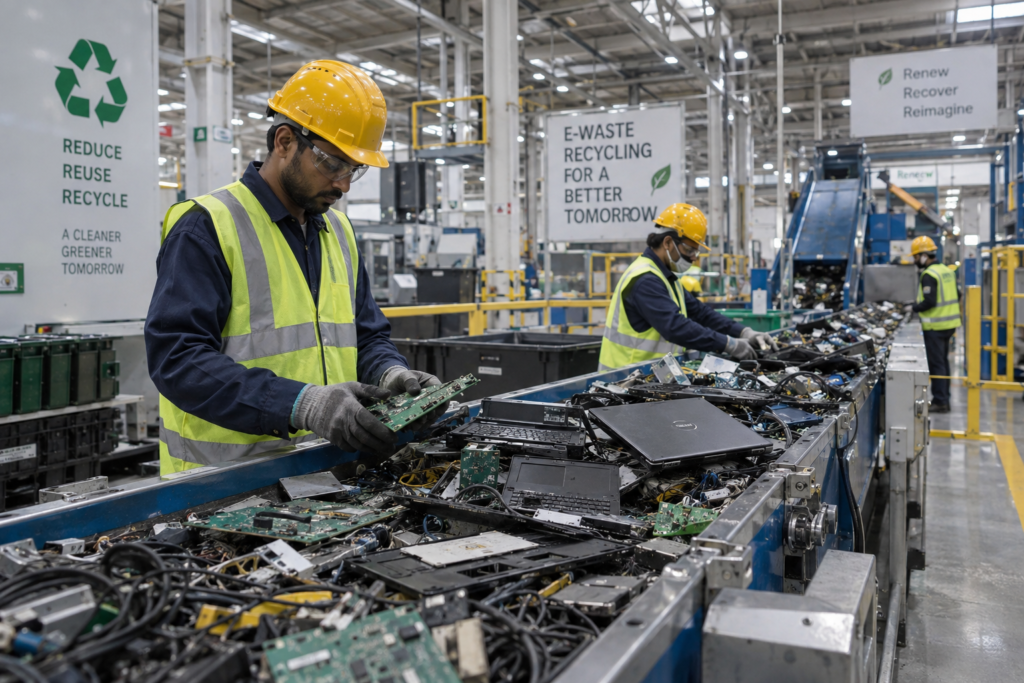
Recyclekaro’s process is more industrial chemistry than junkyard sorting. E-waste is collected, manually dismantled, shredded down to 2-3 inch particles, and then run through density separation and eddy current separation to pull out copper, aluminium, gold, platinum, and other recoverable metals.
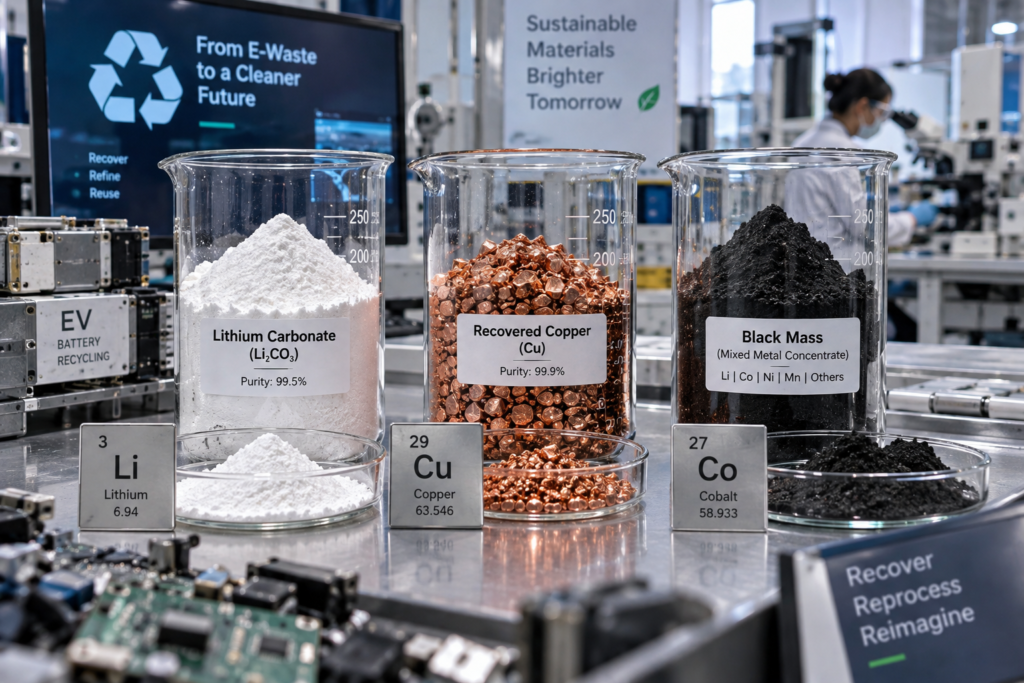
Battery recycling follows a separate hydrometallurgical route: damaged or end-of-life lithium-ion batteries are shredded into “black mass,” then processed through solvent extraction to recover lithium carbonate, cobalt sulfate, nickel sulfate, and manganese sulfate — with a zero-discharge system that converts the plant’s final waste output into reusable sodium sulfate rather than releasing it into the environment.
How the Business Actually Makes Money
It’s worth understanding the economics here, because they’re a little unusual. Recyclekaro effectively earns twice on the same material: once from the fee it charges companies to collect and responsibly dispose of their e-waste or battery scrap — often bundled with recycling certificates that corporates need for ESG reporting and EPR compliance — and again when it sells the recovered metals (lithium carbonate, cobalt, nickel, copper, gold, silver, and rare-earth elements like neodymium) back into industrial supply chains.
The intermediate “black mass” extracted during battery processing is itself a saleable product to other battery manufacturers, and the company has also built out adjacent value-added lines, including recycled aluminium sheet production. The bigger strategic bet is around positioning the company as a domestic source of critical battery minerals — reducing India’s reliance on imports, largely from China, for materials that its EV and electronics industries increasingly depend on.
A Client List That Signals Trust
Recycling is a business built on trust — companies handing over sensitive IT hardware or hazardous battery waste need to know it’s being disposed of properly, with documentation to match. Recyclekaro’s client roster reflects that: on the automotive and battery side, it counts Tata Motors, Bajaj Auto, Ather Energy, and Hero MotoCorp among its partners, with a dedicated EV-battery recycling tie-up with Bajaj Auto and a vehicle-recycling joint venture, Evergreen Vaahan Recycling. On the enterprise e-waste side, its client list includes Capgemini, Accenture, Infosys, Wipro, Union Bank of India, Bank of Baroda, Tata Communications, BSNL, the National Stock Exchange, and the Reserve Bank of India.
For a 16-year-old company, that’s a fairly institutional customer base — the kind that tends to come with strict vendor audits and compliance checks, not the kind of business a fly-by-night recycler typically wins.
Leadership Behind the Growth
Rajesh Gupta, the founder and Managing Director, has run the company since 2010 and is generally the public face of its strategy — from the pivot into lithium-ion recycling to its more recent push into rare-earth recovery. He’s joined by Prassann Daphal as Chief Executive Officer, who oversees day-to-day operations and commercial strategy, and Rajiv Sanghvi as Chief Operating Officer. Together the trio bring a combined 60-plus years of experience to a company that has scaled quickly from a single dismantling unit into a multi-site recycling operation with an in-house R&D bench reported at roughly 22 people, including PhDs and IIT-trained metallurgists.
The Numbers Behind the Growth
Recyclekaro’s revenue has nearly tripled in two years — from about ₹75.5 crore in FY23 to ₹125.3 crore in FY24 and roughly ₹218.8 crore in FY25, a jump of close to 75% in the most recent year alone. Profitability has scaled even faster: profit after tax rose from ₹8.5 crore to ₹22.4 crore over the same period, more than doubling in FY25.
| Metric (₹ crore) | FY23 | FY24 | FY25 |
|---|---|---|---|
| Revenue | ~75.5 | ~125.3 | ~218.8 |
| EBITDA | ~12.0 | ~18.3 | ~36.5 |
| Profit After Tax | ~8.5 | ~9.4 | ~22.4 |
Third-party platforms tracking private-market transactions have pegged the company’s indicative valuation at around ₹1,800-2,100 crore as of September 2026, implying a fairly rich earnings multiple for a company of this size — a reflection of how much growth investors are pricing in for India’s still-nascent battery recycling sector, rather than of current profitability alone.
(These figures are compiled from private investment research and third-party unlisted-share platforms rather than the company’s own published annual report — worth independently verifying against filed financials before treating them as final.)
Evergreen Recyclekaro Pre IPO: Funding & the Path to a Listing
Recyclekaro has been raising institutional capital since around January 2020, with Ascent Capital coming in as a Series A investor in early 2022. Funding trackers put its total capital raised somewhere in the $14-18 million range across seven to eight rounds — the exact figure varies depending on which disclosures a given tracker counts — with a further round reported in February 2026.
In early 2026, the company reportedly said it was targeting a fresh raise of around ₹240 crore to fund new facilities, expand its extraction capabilities, and scale capacity further. An IPO is described as under consideration as part of a broader push to institutionalize the business, though as of now there’s no confirmed listing date, making this strictly an Evergreen Recyclekaro pre IPO opportunity for now.
Why the Timing Matters
India’s e-waste generation rose nearly 73% in just five years — from about 1.01 million tonnes in 2019-20 to roughly 1.75 million tonnes in 2023-24, according to government data presented in Parliament. The government’s revised E-Waste (Management) Rules, 2022, in force since April 2023, now legally require electronics manufacturers to meet Extended Producer Responsibility (EPR) targets for recycling — a regulatory push that favors formal, authorized recyclers like Recyclekaro over the informal scrap sector.
More broadly, India’s circular economy transition — of which recycling is a core piece — could generate as much as $218 billion in annual value by 2030 and $624 billion by 2050, according to research cited by the India Brand Equity Foundation (IBEF). Battery recycling specifically is shaping up to be an even bigger opportunity within that: with India’s EV adoption accelerating, JMK Research estimates the domestic lithium-ion battery market could reach 132 GWh by 2030 — a potential billion-dollar recycling opportunity for companies equipped to handle it safely.
That combination — a fast-growing waste stream, tightening regulation, and very few formal players capable of doing the job properly — is the backdrop against which Recyclekaro has been scaling.
What the Evergreen Recyclekaro Pre IPO Means for Investors
Evergreen Recyclekaro remains a private, unlisted company — there’s no confirmed listing date, and like most companies at this stage, its shares change hands only through off-market, private transactions rather than a stock exchange.
As with any Pre-IPO Investment, it’s worth keeping in mind that these shares are illiquid, valuations can move significantly between private funding rounds, and there’s no guarantee the company lists on a public exchange at all. Before investing in any Evergreen Recyclekaro Pre IPO shares, it is crucial to understand that due diligence and a long time horizon matter more here than they do with listed stocks.
Evergreen Recyclekaro pre IPO: Common Questions
Is it legal to buy unlisted shares in India?
Yes — buying and selling unlisted shares is legal and is routinely done through off-market transfers between Demat accounts, though the process isn’t regulated in the same comprehensive way the listed stock market is.
How is Recyclekaro different from other e-waste recyclers in India?
Most Indian e-waste recyclers stop at dismantling and basic material sorting. Recyclekaro goes further, running full hydrometallurgical extraction in-house to produce battery-grade outputs like lithium carbonate and cobalt sulfate — plus dedicated EV-battery infrastructure most peers haven’t built yet, in a segment that’s still fairly early in India.
What happens to the lock-in period if Recyclekaro eventually lists?
Under current SEBI rules, retail investors and HNIs face a six-month lock-in from the listing date if a company goes public on the main board; SME IPOs carry a one-year lock-in instead. There’s no lock-in on the private, off-market transfers that happen before any listing.
How are gains from unlisted shares taxed?
Shares sold within 24 months of purchase are taxed as short-term capital gains at your regular income tax slab rate. Hold them longer than that, and gains qualify for long-term treatment — taxed at a flat 12.5% since the July 2024 budget changes, without the indexation benefit that used to apply. It’s worth checking with a tax advisor for how this applies to your specific situation.
What’s the biggest risk here?
Mainly illiquidity and uncertainty — there’s no public market to exit quickly, prices can swing between funding rounds, and there’s no guarantee Recyclekaro ever lists at all. This is a long-horizon, do-your-own-research kind of investment, not a quick trade.
The Bigger Picture
What’s clear is that Recyclekaro has built something more substantial than a typical scrap business — a formally regulated, technically sophisticated operation serving some of India’s largest companies, in a sector the government is actively pushing to formalize, backed by institutional investors and now weighing its own path to the public markets. Whether that translates into a strong public listing down the line is still an open question, but the underlying growth numbers suggest it’s one worth watching.