
- 3.8 M
Garuda Aerospace
₹432
- 187.16%
Max
Garuda Aerospace
₹432
Garuda Aerospace
₹432
About
Garuda Aerospace Limited
1. The core idea
Garuda doesn’t position itself as a drone manufacturer. It positions itself as an integrated drone platform — one modular airframe, re-missioned by swapping payloads, sold either as hardware or as an outcome.
That single design choice is what lets one company claim six verticals. The same frame carries a spray tank for a farm, a multispectral sensor for a survey, a thermal camera for a chimney inspection, or an ISR payload for a defence customer.
2. Two revenue engines
1. Product sales — ₹99.4 crore (48% of FY26 revenue)
Selling drones and drone parts outright. Recognised at a point in time. Buyers are dealers, agri machinery companies, PSUs, and government schemes like Namo Drone Didi. Lumpy, tender-driven, one-time.
2. Drone-as-a-Service — ₹106.5 crore (52%)
The customer buys the outcome, not the asset. Garuda sends its own fleet and pilots, does the spraying or the survey or the inspection, and hands over processed data. Recognised over time.
This is the half management leans on, and it did overtake product sales in FY26 (in FY25 the two were nearly equal at ₹59.7 crore vs ₹57.8 crore). The pitch is that it removes the customer’s capex barrier and gives Garuda recurring revenue instead of one-time hardware sales.
Worth noting what isn’t a separate line: training, software, and after-sales are described as verticals but aren’t disclosed as revenue streams. They fold into these two buckets. Exports are zero.
3. The value chain they claim to own
Design and R&D → manufacturing and assembly → DaaS operations → AI and data analytics → MRO and after-sales → mission planning and fleet software → defence systems.
The strategic argument is backward integration — localising components to control cost and comply with indigenisation norms. CY24 added BIS-certified Li-Po battery manufacturing.
4. The moat, as they frame it
Dual DGCA approval for both manufacturing and training. It’s the one genuinely hard-to-copy asset here. It unlocks BVLOS and government or defence-linked missions without depending on a third party, which is exactly where the large contracts sit. VLOS-only competitors are structurally locked out of those tenders.
The RPTO flywheel. 300+ training centres across 22 states, 2,000+ certified pilots, second-largest RPTO in India. Every trained pilot is a potential DaaS operator, dealer, or customer — the training business seeds the demand for the service business.
Ecosystem lock-in. Dealers, service partners, educational institutions, government agencies, and enterprise customers, plus a growing after-sales and AMC layer.
5. What the cost structure reveals
This is where the stated model and the actual model diverge a bit.
Cost of materials was ₹116.8 crore in FY26 — but ₹51.9 crore of that is outsourced contract cost, a quarter of total revenue. Employee costs are just ₹8 crore for a claimed 200+ team, and R&D spend was ₹1.24 crore, or 0.6% of revenue.
So the honest description isn’t “vertically integrated manufacturer.” It’s closer to an orchestrator — Garuda owns the certifications, the customer relationships, the brand, and the pilot network, and contracts out a large share of the actual building and flying. That’s a legitimate model, and it’s what keeps the balance sheet light (D/E of 0.09, only ₹18 crore of PP&E). But it means the value capture sits in regulatory access and distribution, not in proprietary technology.
6. Who pays, and how well
Single operating segment, 100% India. Customer concentration improved sharply — the top customer was 7.77% of revenue in FY26, down from a single customer at 38% of product sales in FY25.
The catch is when they pay. Customer advances at year-end were only ₹3.4 crore, so this isn’t a prepaid business. Receivables are ₹234 crore against ₹206 crore of revenue, at 415 debtor days.
Which reframes the model: it’s an asset-light business that has become extremely working-capital-heavy. Garuda doesn’t tie up capital in factories — it ties it up in funding its customers’ payment cycles. That’s the structural feature that drove two straight years of negative operating cash flow, and it’s the thing worth watching more than the vertical count.
Create Alert
|
Metric |
Value |
|
Share Price |
₹432 per equity share |
|
Lot Size |
100 shares |
|
52 Week High / Low |
₹495 / ₹425 |
|
Depository |
NSDL & CDSL |
|
PAN Number |
AAGCG1621A |
|
ISIN Number |
INE0REL01021 |
|
Market Cap |
₹2,231 crore |
|
P/E Ratio |
85.77
|
|
P/B Ratio |
9.23 |
|
Debt to Equity Ratio |
0.09 |
|
Return on Equity (ROE) |
10.85% |
|
Book Value |
46.35 |
|
Face Value |
2 |
|
Total Shares |
5,29,94,060
|
Got Questions?
Let Us Help
How to buy unlisted Garuda Aerospace shares online in India?
You can invest in Garuda Aerospace unlisted shares through platforms like Pre IPO Investment by completing a standard KYC and agreement process. Once the transaction is finalized, the shares are credited within 1-5 business days directly to your Demat account.
What is the minimum ticket size (investment amount) required for Garuda Aerospace?
The minimum investment amount depends on the current share price and lot size. For Garuda Aerospace, the lot size is strictly 100 shares. With the current price at ₹432 per equity share, the minimum ticket size (investment amount) is ₹43,200 per transaction.
What is the current share price and estimated valuation of Garuda Aerospace?
Based on current data, the share price of Garuda Aerospace is ₹432 per equity share. The company’s estimated market capitalization (valuation) sits at ₹2,252 crore.
(Note: Unlisted prices fluctuate based on market supply and demand).
Is it legal to buy Garuda Aerospace unlisted shares in India?
Yes, trading Garuda Aerospace unlisted shares is completely legal in India through private placement and off-market transfers. However, investors should note that Pre IPO Investment is a facilitation platform — not a SEBI-registered stock exchange or broker.
How can I sell my Garuda Aerospace unlisted shares — before or after the IPO?
Before an IPO, you can sell your holdings through unlisted share dealers or facilitation platforms. However, after any future listing, a SEBI-mandated lock-in of 6 months typically applies to all pre-IPO investors before they can sell those Garuda Aerospace shares on the public exchange.
Are there any hidden charges or brokerage fees when buying Garuda Aerospace shares?
We aim for complete transparency, and our platform displays an all-inclusive price. However, always verify if there are any applicable processing fees, government stamp duty, or specific Demat transfer charges before finalizing your purchase of Garuda Aerospace shares.
What is the tax on capital gains when I sell Garuda Aerospace unlisted shares?
Unlisted shares follow distinct tax rules. Generally, if held for less than 24 months, it is considered a Short-Term Capital Gain (STCG) taxed at your applicable income slab rate. If held for more than 24 months, Long-Term Capital Gains (LTCG) typically apply at 12.5% (as per recent tax revisions), but you should always consult a chartered accountant for your specific tax liabilities.
What are the risks of investing in Garuda Aerospace unlisted shares before its IPO?
Key risks include illiquidity (it can take time to find a buyer in the private market), price volatility between funding rounds, and the possibility that the IPO gets delayed or canceled. Thorough due diligence and a long-term investment horizon are essential when investing in Garuda Aerospace.
Our blogs
Find what's next
By Pre IPO Investment Research Team • Published September 9, 2026 Quick Facts — Evergreen Recyclekaro (India) Limited Pre IPO Founded 2010, by Rajesh Gupta Headquarters Navi Mumbai, Maharashtra Leadership…
- September 23, 2026
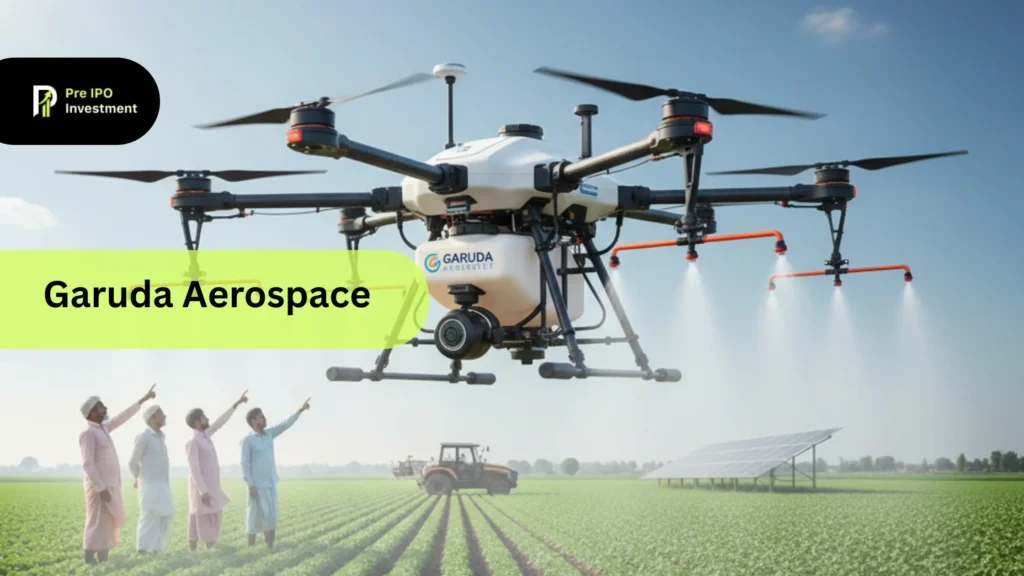
Garuda Aerospace closed FY25 with stronger profits, rising revenues, and a clear roadmap for IPO and exports. If you are tracking the drone sector or planning your next investment, this…
- November 7, 2025